
Edited by Salā George Carter, Gregory Fry and Gordon Leau Nanau
Year of publication: 2025
Foreword
Afioga Fiamē Naomi Mata’afa
The story of diplomacy in the Pacific is often told through a narrow lens—one shaped by the rise of the modern nation-state and the formalities of Western practice since independence. Yet, as this volume so powerfully reveals, the art of persuasion or negotiation, reconciliation, and relationship-building has been woven into the life of Oceania for thousands of years.
The story of diplomacy in the Pacific is often told through a narrow lens—one shaped by the rise of the modern nation-state and the formalities of Western practice since independence. Yet, as this volume so powerfully reveals, the art of persuasion or negotiation, reconciliation, and relationship-building has been woven into the life of Oceania for thousands of years. Long before colonial boundaries or international conventions, our islands, clans, and chiefly systems were navigating their own pathways of peace, alliance, and exchange across the vast Pacific Ocean.
FRONT MATTER
Acknowledgments
Carter, George
Fry, Gregory
Nanau, Gordon Leau
This book was inspired by the observation that diplomacy, as taught in Pacific universities and foreign policy academies, is generally based on western concepts and institutions and continues to ignore the principles and practices of diplomacy which operated for hundreds of years between Pacific polities before colonisation…
FULL EXCERPT: This book was inspired by the observation that diplomacy, as taught in Pacific universities and foreign policy academies, is generally based on western concepts and institutions and continues to ignore the principles and practices of diplomacy which operated for hundreds of years between Pacific polities before colonisation. Not only does this ignore a rich and deep history of Oceanic diplomacy; it also seemed to us that it was ignoring the continuing relevance and potential value of these traditional diplomatic ideas and practices for contemporary interstate diplomacy in the Pacific regional diplomatic arena.
FRONT MATTER
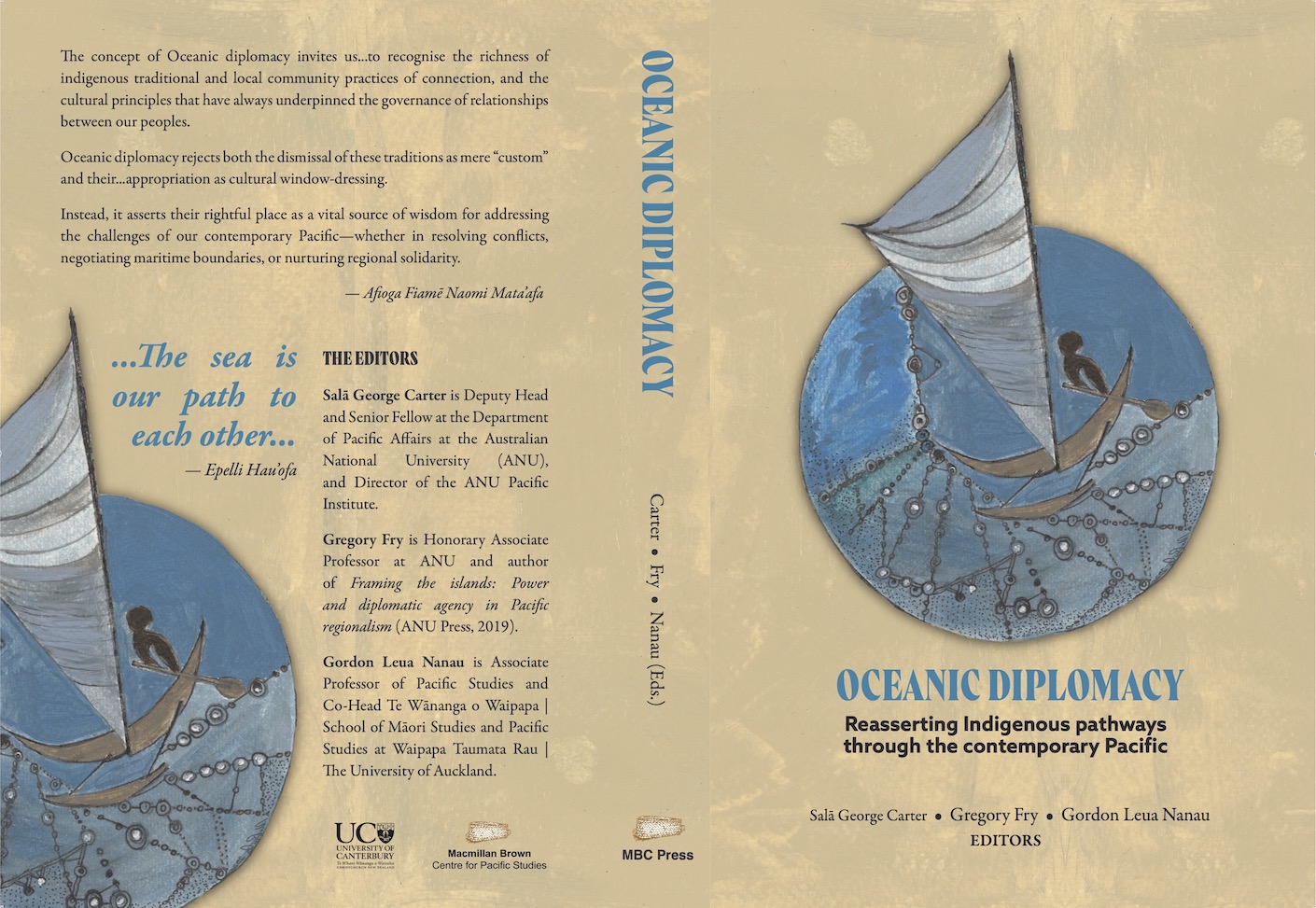
Connecting the dots: Artist’s notes on the cover art
Bulamaibau, Ulamila
The intention is to have an effect such that the navigator, the traveler with his canoe, is projected off the cover, off the globe (the circle), in his quest or mission for ocean diplomacy on pathways wherever that will take him.
FULL ABSTRACT: The intention is to have an effect such that the navigator, the traveler with his canoe, is projected off the cover, off the globe (the circle), in his quest or mission for ocean diplomacy on pathways wherever that will take him. I needed to be inclusive as well so the connectivity and the design needed to be representative of the various communities.
CHAPTER 01
‘Oceanic diplomacy’ as concept and practice
Carter, George
Fry, Gregory
Nanau, Gordon Leau
In this book, we refer to these longstanding practices and principles as Oceanic diplomacy to emphasise that what we are seeking to bring into the light are forms of diplomatic knowledge, and forms of diplomatic practice, that spring from the history and cultures – and even from the winds and currents – of Oceania itself.
FULL EXCERPT: When practitioners and scholars think of Pacific diplomacy, they usually have in mind a form of diplomacy built on Western practices and protocols, and focused on the engagement between modern sovereign Pacific Island states and their accredited ambassadors. Seen through this lens, Pacific diplomacy is assumed to begin in the late 1960s with the beginning of decolonisation and the creation of the postcolonial state. What is overlooked in this conventional narrative is that prior to the emergence of Western-style diplomacy there were hundreds, even thousands, of years in which the political communities of Oceania practised diplomacy between themselves. In this book, we refer to these longstanding practices and principles as Oceanic diplomacy to emphasise that what we are seeking to bring into the light are forms of diplomatic knowledge, and forms of diplomatic practice, that spring from the history and cultures – and even from the winds and currents – of Oceania itself. In this book, we refer to these longstanding practices and principles as Oceanic diplomacy to emphasise that what we are seeking to bring into the light are forms of diplomatic knowledge, and forms of diplomatic practice, that spring from the history and cultures – and even from the winds and currents – of Oceania itself.
CHAPTER 02
Pre-colonial regional systems in Oceania
D’Arcy, Paul
This chapter examines the longue durée of Pacific regional networks from 1500 CE onwards…
FULL EXCERPT: This chapter examines the longue durée of Pacific regional networks from 1500 CE onwards. These networks fulfilled key objectives and needs that saw them emphasised and maintained even in circumstances of local self-sufficiency. They also endured into the colonial era and after independence. The geographical extent and enduring quality of these networks in global terms challenges political theory’s conventional assumption that centralised authority harnessing collective resources is vital to meet existential threats. Regular indigenous Tahiti-centred networks, for example, stretched the equivalent distance of Paris to Moscow. These vast networks – held together by emphasising local autonomy, fluid responses to environmental challenges, and trans-local higher authority – lost consent if they failed to return local benefit. In this regard, these enduring Pacific institutions hold lessons for all of humanity and for modern Pacific regional discourse.
CHAPTER 03
Diplomacy and the pursuit of peace in pre-Christian Fiji
Nicole, Robert
By digging beneath the grand narrative of Fijian warfare, by reading documents ‘against the grain’, and by combing the archive for traces of cultures of peace, I argue that Ratu Lewenilovo’s claim can be unsettled. Pre-Christian Fijians enjoyed substantial periods of peace, because they had developed a wide array of diplomatic mechanisms…
FULL EXCERPT: An often-quoted statement in the early 1840s by the Cakaudrove chief Ratu Lewenilovo to the resident British missionary Thomas Williams claimed that Fijians were ‘like the ocean’, caught up in an endless cycle of ebbs and flows that did not allow them any rest. ‘We know no peace,’ he told Williams (1858/1982, p. 128; see also Henderson in Williams, 1931, p. 327, Footnote 52). This statement is one of many that have formed the dominant narrative about pre-Christian Fiji: that it was a dark and violent age of incessant warfare in which peace was non-existent.
This chapter offers an alternative reading of Fiji’s history, one that challenges this view. It asks whether ordinary Fijians and their leaders ever reached political settlements without resorting to violence, and if so, how? By digging beneath the grand narrative of Fijian warfare, by reading documents ‘against the grain’, and by combing the archive for traces of cultures of peace, I argue that Ratu Lewenilovo’s claim can be unsettled.
CHAPTER 04
Reconnecting the heartlands of Ocean-Pacifika through salutations: Ai cavuti, fa‘alupega, fakatāpū
Tuimaleali’fano,
Atoese Morgan
and D’arcy, Paul
This chapter argues that reconnecting the heartlands of Ocean-Pacifika is about reconnecting the heart to place and people – families of belonging, near and far – through enduring institutions rooted in respect. Salutations and ceremonial greetings are ancestral devices that provide the means by which peoples’ hearts are approached, and perhaps mended and reconnected.
FULL EXCERPT: Pacific Islanders have explored, developed and nurtured their island homes for millennia. Regular community interactions involving sophisticated diplomatic protocols were a fundamental part of Pacific peoples’ success in this process. However, modern academic scholarship borne out of Western disciplines, colonial tactics to secure political control through indirect rule, and post-independence nation-building agendas, have tended to emphasise economic exchanges and political alliances over social protocols, customs and other, more nuanced, political relationships. This is because these features were more readily observable in the archaeological record or evident to European outsiders lacking intimate familiarity with the inner cultural logic of Pacific societies. This chapter argues that reconnecting the heartlands of Ocean-Pacifika is about reconnecting the heart to place and people – families of belonging, near and far – through enduring institutions rooted in respect. Salutations and ceremonial greetings are ancestral devices that provide the means by which peoples’ hearts are approached, and perhaps mended and reconnected.
CHAPTER 05
Giving one’s word and giving one’s paper: Hybrid diplomatic agreements between indigenous Pacific states in the 19th century
Gonschor, Lorenz
While a lot has been written about such – often highly unequal – written contracts and treaties between Westerners and Islanders, and their ramifications until today, little attention has been paid to the fact that Western ways of formalising intercommunal relations also influenced the development of relations between indigenous Oceanian polities.
FULL ABSTRACT: Over centuries, the peoples of Oceania developed various procedures and protocols to organise relations at various levels of political organisation, such as between families, villages, tribes or larger entities such as chiefdoms, tribal confederacies or kingdoms. Several chapters in this book deal with these systems in great detail. With European contact, however, Oceanian societies were confronted with a different kind of diplomatic relations, centred on the written word. Even before missionaries had reduced indigenous languages to writing, visiting Europeans expected to regulate their relations with Island communities by way of papers they asked Islanders to sign.
While a lot has been written about such – often highly unequal – written contracts and treaties between Westerners and Islanders, and their ramifications until today, little attention has been paid to the fact that Western ways of formalising intercommunal relations also influenced the development of relations between indigenous Oceanian polities. Similar to other developments in statecraft mixing traditional and European elements – the creation of law codes, constitutions, royal palaces and other government buildings come to mind – the 19th century saw the development of hybrid diplomatic practices that combined indigenous and Western forms. My use of the term ‘hybrid’ here is based on that of Kamanamaikalani Beamer, who, conceptually influenced by Homi Bhabha, has popularised the term ‘hybridity’ in his various publications on the Hawaiian Kingdom (Beamer, 2014; Bhaba, 1994). In this chapter, I will examine this phenomenon by way of three case studies chronologically spread across almost the entire 19th century.
CHAPTER 06
Aboriginal Australian diplomacy as Oceanic diplomacy
Brigg, Morgan
Graham, Mary
A key challenge and struggle then, especially given the submersion of non-Western forms of diplomacy in dominant discourse, is to find ways to introduce and begin to discuss (Ab)original people’s ways of conceptualising and conducting diplomacy that pay due care and respect to human differences while also contending with the realities of settler colonialism.
FULL EXCERPT: The original peoples of the Australian continent have for millennia fashioned ways of organising being together and relating with each other. These forms of political ordering and diplomacy deserve to be considered alongside other forms of human being-together, which taken together, militate against univocal conceptualisations of diplomacy based in easy yet erroneous distinctions between ‘primitive’ and ‘modern’ peoples (Numelin, 1950; cf. Mair, 2006). However, contemporary and commonplace understandings of diplomacy overwhelmingly evoke this distinction by focusing upon diplomacy as the relatively recent practices among European-derived sovereign states. The emergence and consolidation of this form of political and inter-polity ordering is a story of domination that comes to us through imperialism, colonialism, development and globalisation. The accompanying history sets for us the task, both ethical and scholarly, of reopening and re-expanding our conceptualisations of diplomacy. The diversity of the world’s peoples obliges us to engage with fellow human beings to strive for more engaged and representative knowledge. This task of telling more complete human stories of diplomacy requires us to unlearn dominant ways of thinking about diplomacy and to recuperate and engage with the inter-polity ordering of diverse peoples of the world.
CHAPTER 07
Popo and supu diplomacy in the modern state of Solomon Islands
Nanau, Gordon Leau
The chapter explores the centrality of popo and supu making, display and presentation in social interactions and diplomatic engagements among indigenous Guadalcanal people and beyond. It looks at the significance of the wooden food bowl, the coconut spoon and related local valuables such as rongo vatu (shell money), be (pigs) and vanga (root and fruit crops, or foodstuffs in general).
From the nughu (gravel bar) of the Lathi River, Guadalcanal, one can see from a distance the magnificent sight of Mount Popomanaseu. It is the highest peak on the island and entire Solomon Islands. Indigenous Guadalcanal inhabitants call it popo-mana-seu in reference to popo (wooden food bowl) and seu niu (coconut shell spoon), as it resembles these important utensils from a distance. Why is such a name given to a peak that stands out from the other mountain ranges on Guadalcanal? On deeper reflection, the name matches the central role that popo mana seu and supu2 (heap of root crops) play in Guadalcanal intertribal and inter-clan etiquette and diplomacy.
CHAPTER 08
Malaitan traditional diplomacy in national politics
Hiriasia, Tony
This chapter discusses the use of traditional diplomacy by the Malaita Alliance for Rural Advancement (MARA) government led by premier Daniel Suidani in the period from 2019 to 2023.
FULL EXCERPT: In Solomon Islands, it is not uncommon for political disputes to be settled through the use of traditional diplomacy and conflict resolution practices. The use of traditional diplomacy and reconciliation practices is appealing for political spaces because of their focus on restoring relationships between concerned individuals or parties. Therefore, politicians tend to favour traditional diplomacy and reconciliation practices as means to resolve political disputes, hence maintain their numbers and hold parties or coalitions together. This chapter discusses the use of traditional diplomacy by the Malaita Alliance for Rural Advancement (MARA) government led by premier Daniel Suidani in the period from 2019 to 2023. During this period, MARA resorted to traditional dialogue and diplomatic practices to rebuild political relationships and settle political disputes within the Malaita Provincial Government (MPG) and, specifically, the MARA coalition.
CHAPTER 09
Haus krai: national symbol for grief and outcry, and a Melanesian space for diplomacy
Meki, Theresa
Drawing on this and three other high-profile haus krai occasions, this chapter conceptualises the Melanesian haus krai phenomenon as a potential site for Indigenous diplomacy in that it fosters the ideal atmosphere to restore and strengthen relationships, allowing for freedom of speech – however assertive or even critical – and fostering an atmosphere for building consensus.
FULL EXCERPT: Haus krai – the space and place for sharing grief over a beloved deceased person – is pervasive throughout the ethnically diverse landscape of Papua New Guinea (PNG). This staple of PNG’s traditional economy, culture and society has continued into the urban modern setting, albeit in a hybrid format. The activities performed in a haus krai, and their implications, carry literal and figurative weight that sustains connection to place (ethnic village), identity, kin and belonging. In the last decade, this mourning custom, and the term haus krai itself, have become national symbols for grief and outcry. During March 2021, upon the passing of PNG’s first Prime Minister Michael Somare, a 10-day national haus krai was held at Port Moresby’s Sir John Guise Indoor Complex…Drawing on this and three other high-profile haus krai occasions, this chapter conceptualises the Melanesian haus krai phenomenon as a potential site for Indigenous diplomacy in that it fosters the ideal atmosphere to restore and strengthen relationships, allowing for freedom of speech – however assertive or even critical – and fostering an atmosphere for building consensus.
CHAPTER 10
A Kanak way of being to the world: The appropriation of customary diplomatic protocols in new political contexts
Tutugoro, Anthony
The question is, therefore, how can the protocols inherent in Kanak culture be transformed into a diplomatic culture of engagement specific to New Caledonia?
FULL EXCERPT: The customary protocols immanent to the roots of Kanak civilisation are increasingly used in New Caledonia to initiate encounters of all kinds, in terms of social, cultural and political practices, by all ethnic forms of the population. It is interesting to observe how these protocols, part of an age-old diplomacy, could – by becoming widespread throughout New Caledonia – progressively become the markers of a diplomacy and a culture of engagement specific to this Pacific territory, which is still under French sovereignty. The question is, therefore, how can the protocols inherent in Kanak culture be transformed into a diplomatic culture of engagement specific to New Caledonia?
CHAPTER 11
Traditional diplomacy in the Mortlock Islands
Puas, Gonzaga
The purpose of this chapter is to discuss traditional diplomacy in the Mortlock region, and how such diplomacy was developed and sustained by the inhabitants of this low-lying chain of islands throughout history.
FULL EXCERPT: Diplomacy is a fundamental and intricate part of Mortlockese political history and continuity. Like their traditional sailing mats made from pandanus leaves, strands are woven together to harness the oceanic winds to control the movement of the canoe as it navigates itself upon the turbulent sea. This movement is about negotiating successive waves of uncertainties to enable the canoe to get to its final destination. Sailing created a network of sea lanes for inter-island interactions throughout history. It developed people’s characters and personalities as well as shaping communities to coexist harmoniously. The sea is therefore the birthplace of Mortlockese diplomacy, wherein all interactions with and across the sea work to maintain peace and harmony across the region.
CHAPTER 12
The Keamu Accord, kastom and maritime boundaries
Macllelan, Nic
For this reason, the signing of the Keamu Accord is a striking example of ‘Oceanic diplomacy’.
FULL EXCERPT: The 2009 Keamu Accord highlights the multilayered, often intersecting, processes that make up this Oceanic diplomacy in a modern context. It features: cultural connections across colonial boundaries between chiefs and clans; the use of oral history and legend to inform contemporary diplomatic relations; strengthened relations between political elites and local customary leaders; efforts by a national liberation movement to reinforce ties with a neighbouring independent state; and political diplomacy within a subregional organisation, the Melanesian Spearhead Group (MSG).
CHAPTER 13
Oceanic diplomacy: Learning from talanoa diplomacy
Tarai, Jope
This chapter argues that the talanoa concept was co-opted by the Bainimarama government within the Fiji state, which subsequently resulted in the appropriation of a shared Oceanic concept and reckless exotification of Fijian indigeneity.
FULL ABSTRACT: The Talanoa Dialogue introduced in 2017 to the United Nations Conference of the Parties (COP 23) by the then Fiji prime minister, Voreqe Bainimarama, was hailed a success in replacing the initial structured Facilitative Dialogue format. The Facilitative Dialogue had been intended as a stocktaking exercise to review the collective contributions of parties towards their commitment to the Paris Agreement in 2015. The design and modality of the Facilitative Dialogue was an ongoing process, which Fiji capitalised on to amplify the prime minister’s international profile, in his new role as the COP23 president. To amplify and distinguish his COP23 presidency, Bainimarama and his team rebranded Facilitative Dialogue as Talanoa Dialogue. This rebranding was an obvious attempt at Oceanic indigenisation of international diplomacy, as a marker of distinction for the term of the COP23 presidency. The Bainimarama government subsequently emphasised Oceanic and cultural values related to talanoa as a concept.
CHAPTER 14
‘The steering paddle of our canoe’: Culture in Vanuatu’s diplomatic practice
Naupa, Anna
This chapter explores how Vanuatu has integrated constitutional commitments to cultural diversity and traditional Melanesian values into diplomatic practice, to identify themes of relevance to Oceanic diplomacy.
FULL EXCERPTS: This chapter explores how Vanuatu has integrated constitutional commitments to cultural diversity and traditional Melanesian values into diplomatic practice, to identify themes of relevance to Oceanic diplomacy. It briefly sketches Vanuatu’s transition from pre- independence indigenous activism to postcolonial modern diplomacy, then reviews three 21st century diplomatic milestones through the lens of Vanuatu culture to identify key elements for Oceanic diplomacy. Drawing from Vanuatu’s founding diplomatic principles and interviews with key officials, it highlights themes of relationality, reconciliation, unity and peacebuilding, illustrated through three vignettes:
CHAPTER 15
Mā whero, mā pango ka oti te mahi: The role of indigenous diplomacies in the success of the 1997 Burnham peace talks
Evett, Jayden
This chapter explores how and why indigenous cultural practices contributed to the success of the 1997 Burnham talks. I analyse two key diplomatic practices to identify their impact: Melanesian trautim1 and Māori pōwhiri.
At the heart of the Burnham talks lies a puzzle: how did they produce enduring agreements where earlier attempts had been unable to do so? The most common answer, that the conflict was ‘ripe’ for resolution, ignores that ‘ripeness’ had arguably been reached several years earlier. Some answers make passing mention of indigenous cultural practices as a factor (e.g. Hayes, 2005; Miriori, 2002), though often without substantive investigation. This leaves open some big questions: Were these practices simply cultural window-dressing for political talks? Or should they be seen as an essential factor in the success of the Burnham talks, in creating a circuit breaker in the failed peace process? What complicates this puzzle is that any success of these cultural practices would challenge conventional negotiation methods and the conflict logic they are built upon.
CHAPTER 16
The evolution of the Samoan ifoga: From kinship ritual to diplomatic practice
Mataia Milo, Tuala Saui’a Louise
This chapter argues that the Samoan ifoga ritual serves as a critical case study for understanding Oceanic diplomacy, challenging Western-centric views by illustrating how indigenous practices have evolved into a multifaceted tool for conflict resolution, national politics and international relations.
FULL EXCERPT: In 2002, during a formal apology from the New Zealand Prime Minister Helen Clark to the people of Samoa, the Government of Samoa gifted a fine mat, ‘Le Ageagea o Tumua’, in return. Only a few understood the weight of this exchange, and of the ifoga ceremony (Samoan traditional ritual of apology and reconciliation) of which it was part. To Western eyes, it was a symbolic gesture, but for the Samoans, it was an integral part of a sophisticated system of relational diplomacy refined over centuries. The persistent notion that diplomacy is a foreign concept introduced to Oceania fails to recognise the rich tradition of diplomatic practices embedded within indigenous cultures across the Pacific.
CONTRIBUTORS
Contributors
N/A