

Executive Summary
Ratuva, Steven
Singh, Awnesh
Hayward, Bronwyn
Iese, Viliamu
Veitayaki, Joeli
La’ala’ai-Tausa, Christina
Waqa-Sakiti, Hilda
et al.
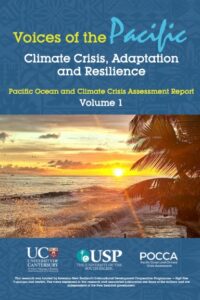
The Pacific Ocean Climate Crisis Assessment project (POCCA) conducted an interdisciplinary, and evidence-based research study of the diverse range of impacts, community experiences, adaptation strategies, community innovations and Indigenous knowledge systems relating to climate change in the Pacific Island Countries and Territories (PICTs). The PICTs covered in the study are Cook Islands, Federated States of Micronesia, Fiji, Kiribati, Nauru, Niue, Palau, Papua New Guinea, Republic of the Marshall Islands, Samoa, Solomon Islands, Timor-Leste, Tokelau, Tonga, Tuvalu, and Vanuatu…..
Led by the University of Canterbury and the University of the South Pacific, it was a rare case of interdisciplinary and trans-national collaboration between the largest group of Pacific Island experts ever assembled for a research project, in the areas of physical science, social science and Indigenous knowledge. It showcased the depth and breadth of Pacific Island-based and Pacific diaspora expertise drawn from universities, research institutions, government agencies and community groups from across the Pacific, New Zealand, Australia, United States and beyond. The project was funded by Aotearoa New Zealand’s International Development Cooperation Programme, administered by the Ministry of Foreign Affairs and Trade.
CHAPTER 01
Introducing the Pacific Ocean Climate Change Assessment (POCCA) Project
Ratuva, Steven
Hayward, Bronwyn
Iese, Viliamu
Veitayaki, Joeli
La’ala’ai-Tausa, Christina
Waqa-Sakiti, Hilda
Holland, Elisabeth
The Pacific Ocean Climate Crisis Assessment (POCCA) project provides an interdisciplinary, multicultural and transnational study of the impacts of climate change and community responses covering 16 Pacific Island Countries and Territories (PICTs): Cook Islands, Federated States of Micronesia, Fiji , Kiribati, Nauru, Niue, Palau, Papua New Guinea, Republic of the Marshall Islands, Samoa, Solomon Islands, Timor-Leste, Tokelau, Tonga, Tuvalu and Vanuatu…
FULL EXCERPT: The Pacific Ocean Climate Crisis Assessment (POCCA) project provides an interdisciplinary, multicultural and transnational study of the impacts of climate change and community responses covering 16 Pacific Island Countries and Territories (PICTs): Cook Islands, Federated States of Micronesia, Fiji , Kiribati, Nauru, Niue, Palau, Papua New Guinea, Republic of the Marshall Islands, Samoa, Solomon Islands, Timor-Leste, Tokelau, Tonga, Tuvalu and Vanuatu. It was in response to the increasing demand for research and evidence-based adaptation and resilience policies, strategies and approaches to address the increasing impacts of climate change. The Pacific leaders as well as various organizations and citizens, have, in various forums, called for a region-wide research such as this to take place.
The project was funded through the Aotearoa New Zealand International Development Cooperation Programme which is administered by the New Zealand’s Ministry of Foreign Affairs and Trade. It is a collaboration between the University of the South Pacific and University (USP) and the University of Canterbury (UC) and involved multiple institutions and organizations across different countries.
POCCA brought together the largest number of Pacific scholars ever to work together collaboratively on a single project. The project helped to transform and enrich the Pacific research culture, regional networking and collaboration in significant ways. Those involved were from all universities in New Zealand (University of Canterbury, University of Otago, Lincoln University, Victoria University of Wellington, Massey University, University of Auckland and Auckland University of Technology) as well as crown research entities such as the National Institute of Water and Atmospheric Research Ltd (NIWA) and Institute of Geological and Nuclear Sciences (GNS); universities from the Pacific region (The University of the South Pacific, National University of Samoa, Fiji National University, Solomon Island National University, University of Papua New Guinea and University of Hawaii); as well as scholars from Australian universities (University of Melbourne, University of Queensland, Grifith University and University of Tasmania).
CHAPTER 02
Framing Climate Science in the Pacific Islands
Singh, Awnesh
Whiteside, Andra
Tu’uholoaki, Moleni
Vaihola, Siosaia
Chinappa, Matthew
Singh, Shalini
Chandra, Ashneel
Muna, Lency
Dehm, Jasha
The climate in the region has been evolving over many decades and Pacific Islanders have been continuously adapting to these changes on a regular basis. Learning from this traditional knowledge and marrying it with current scientific understanding may help in providing adaptation and mitigation strategies for the region.In this chapter, a review of the major climate variabilities affecting the region are discussed with some case studies provided that were conducted in the region to provide an idea of the work done to contribute to and improve our scientific understanding of how the current climate affects the region…
FULL ABSTRACT: The Pacific Islands are highly vulnerable to climate extremes due to their geography, remoteness, and developing economic status. This is further complicated by the impacts of human-induced climate change. While global scientific research on the cause and impacts of climate change has been well documented for most countries, the data from the Pacific region is limited to provide meaningful and confident assessments for the region. The climate in the region has been evolving over many decades and Pacific Islanders have been continuously adapting to these changes on a regular basis. Learning from this traditional knowledge and marrying it with current scientific understanding may help in providing adaptation and mitigation strategies for the region. In this chapter, a review of the major climate variabilities affecting the region are discussed with some case studies provided that were conducted in the region to provide an idea of the work done to contribute to and improve our scientific understanding of how the current climate affects the region.
CHAPTER 03
Climate Change and Ocean Governance in the Pacific: Challenges of Sovereignty and Political Agency
Vaha, Milla
Falefou, Tapugao
Kensen, Matthew
The chapter begins with examples of international ocean and climate regimes in which PICTs have played an influential role as political actors, framing the norms of global governance and international law…
FULL ABSTRACT: Chapter 3 looks at governance of the climate/ocean nexus in the Pacific region. It focuses on Pacific Islands Countries and Territories (PICTs) as global norm entrepreneurs in international and regional frameworks to successfully manage the threats to their sovereign rights at the time of climate crisis. The chapter begins with examples of international ocean and climate regimes in which PICTs have played an influential role as political actors, framing the norms of global governance and international law. It then looks at sea level rise as a threat to state sovereignty in the Pacific region. Furthermore, the chapter looks at the work done by the Pacific Islands Forum to protect regional state sovereignty and maritime boundaries, as well as the innovative national approach adopted by Tuvalu. Finally, the chapter discusses ocean management by looking at the examples of Pacific engagement with critical marine resources.
CHAPTER 04
Regional Climate and Ocean Strategies, Policies and Frameworks – A Stocktake of Current Status
Theys, Sarina
Wairiu, Morgan
Hinge-Salili, Diana
The chapter provides a stocktake and region-wide social mapping of the climate ocean strategies, policies, and frameworks at the regional, national, and local levels in the Pacific…
FULL ABSTRACT: The chapter provides a stocktake and region-wide social mapping of the climate ocean strategies, policies, and frameworks at the regional, national, and local levels in the Pacific. Several declarations, frameworks, agreements, policies, and strategies have been created and implemented. Some of them were framed within the region while others were the result of engagement with external stakeholders. This chapter analyses how these instruments were created and implemented. It also examines the nature of these instruments and how they have shaped the climate ocean agenda. This assessment provides important information on regional and national initiatives, their level of effectiveness, and lessons learned.
CHAPTER 05
‘We are the Moana’ : Climate Risks, Narratives of Vulnerability and Indigenous Pacific Resilience
Hemi, Keaka
Alefaio-Tugia, Siautu
Dumaru, Patrina
Plange, Nii-K
Steven, Hennah
Williams, Shaun
This chapter introduces narratives of vulnerability and Indigenous Pacific resilience as precursors to understanding climate risks to help set the contextual scene for subsequent chapters. Emphasis is made on highlighting key narratives which underscore perceptions of resilience. It discusses elements of historical/ residual legacies and how these influence present perceptions, as well as Indigenous led approaches to reclaim these narratives in support of efforts to shape future adaptation/resilience opportunities.
FULL ABSTRACT: This chapter introduces narratives of vulnerability and Indigenous Pacific resilience as precursors to understanding climate risks to help set the contextual scene for subsequent chapters. Emphasis is made on highlighting key narratives which underscore perceptions of resilience. It discusses elements of historical/ residual legacies and how these influence present perceptions, as well as Indigenous led approaches to reclaim these narratives in support of efforts to shape future adaptation/resilience opportunities. It then highlights inter-related but distinct thought-provoking themes and cases of integrated approaches to inclusion and representation of local, Indigenous knowledge in resilient initiatives and decision-making. The importance of monitoring and evaluating adaptation through Indigenous lenses are discussed to contextualise the significance of such frameworks in relation to inclusivity, sovereignty, uptake of adaptive practices and sustainability at local scales. Lastly, the chapter presents key gaps and takeaway messages in the context of implications/opportunities for policy development.
CHAPTER 06
Pacific Agency and Perceptions of Climate Crisis: Empowering the People’s Narratives
La’ala’ai-Tausa, Christina
Noa, Ashalyna
Timoteo, Mahmah Tohoa Tetini
Daly, Faaosofia
The need for a much more integrated and holistic approach is required to link together various disciplinary approaches, cultural narratives, and policy discourses to strengthen our understanding of the unfolding crisis as well as deepen resilience across the Pacific region. This supports the proposal by the Framework for Resilient Development in the Pacific (FRDP), which aims to promote an integrated focus on climate change and disaster risk management through ‘participatory’ and ‘equitable’ approaches.
FULL ABSTRACT: Over the years, research on climate change and its impact on the region has been wide ranging and much of these have been related to scientific and technical aspects of the climate and ocean as well as studies of impact on local communities. As the climate crisis deepens, the impacts are compounding, with growing risk of cascading consequences. The need for a much more integrated and holistic approach is required to link together various disciplinary approaches, cultural narratives, and policy discourses to strengthen our understanding of the unfolding crisis as well as deepen resilience across the Pacific region. This supports the proposal by the Framework for Resilient Development in the Pacific (FRDP), which aims to promote an integrated focus on climate change and disaster risk management through ‘participatory’ and ‘equitable’ approaches. One such approach is to capture and explore our peoples’ perceptions and narratives of the climate crisis from different perspectives. This helps to mould the understanding around adaptation, mitigation and resilience building in the region. This chapter explores the crucial role of civil society in responding to the climate crisis, examining cultural, operational, and collective approaches. It also critically assesses and identifies educational pathways that can shape and inform ongoing climate crisis debates.
CHAPTER 07
Solwara, Moana, Ocean and Local Communities – The Social, Cultural and Economic Connections
Veitayaki, Joeli
Huffer, Elise
Kensen, Matthew
Kitolelei, Salanieta
Vave, Ron
Vunibola, Suliasi
Young, Luisa
This chapter highlights the diverse and rich narratives through the lenses of researchers. It tells of the sophisticated and organised societies that existed in the Pacific Islands in the past and how the people lived in their island homes today. These rich community experiences and challenges across the Pacific Ocean, arguably the largest carbon sink in the world, and how people have adapted to the climate crisis using culture based responses passed down over generations present useful lessons for Pacific Island communities today and in the years to come.
FULL ABSTRACT: Pacific Islanders are people of the sea: it is their pathway to each other, to the rest of the world, their endless saga and their most powerful metaphor, because ‘the sea is in them.’ Pacific peoples, whose lands are in the world’s largest ocean, have developed unique cultures and knowledge, which include an in depth understanding of their oceanic environment. The people’s customs and cosmologies, livelihood, food security, identity and connections are derived from their small islands and the extensive sea that surrounds them. Over centuries, Pacific people’s ability to adapt has equipped them with the knowledge and skills needed to protect their environment, secure their livelihoods, devise resource use practices and technologies to harness resources of the sea, air and land, trade with their neighbours, and adapt to the environmental hazards of tropical island environments. This is why we should learn from and engage Pacific Island communities and empower them to adapt and build resilience to live in their island communities and assist them in making appropriate choices in response to climate change and its worsening and wide-ranging impacts. This chapter highlights the diverse and rich narratives through the lenses of researchers. It tells of the sophisticated and organised societies that existed in the Pacific Islands in the past and how the people lived in their island homes today. These rich community experiences and challenges across the Pacific Ocean, arguably the largest carbon sink in the world, and how people have adapted to the climate crisis using culture based responses passed down over generations present useful lessons for Pacific Island communities today and in the years to come.
CHAPTER 08
Safeguarding Biodiversity through Indigenous and Local Knowledge for Climate Change Resilience
Challies, Edward
Amosa, Patila
Brodie, Gilianne
N’Yeurt, Antoine De Ramon
Pollar, Edgar
Rashni, Bindiya
Waqa-Sakiti, Hilda
We explore how the interconnected processes of climate change and biodiversity loss threaten balanced social-ecological outcomes on our islands in the Pacific and showcase how climate change responses that are embedded in nature and culture can be led by local communities in partnership with local and national governments. Key policy recommendations and research gaps are also identified, including the need for strengthened connection to the private sector, ecosystem services valuations that clearly reflect the economic value of habitat and biodiversity and a just transition to sustainable economic development via engagement with local communities, business, and industry.
FULL ABSTRACT: This chapter highlights the fundamental importance of biodiversity to the health and spiritual well-being of the Pacific region and people, and to the health of our planet, especially in the context of climate change. The Pacific is internationally recognised for its vast ocean and exceptional biodiversity which for centuries has sustained life, provided food, medicine, and resources for highly diverse cultural and traditional practices. Addressing and mitigating the impacts of climate change on biodiversity in the Pacific region requires a holistic perspective from terrestrial to freshwater and marine environments, including impacts on areas of both high (hotspot) and low (cool spot) biodiversity in unison with the unique human communities they sustain. The importance of local cultures, practices and Indigenous knowledge in maintaining and building responses to climate impacts, such as the role of ‘nature-based’ approaches, are discussed. We explore how the interconnected processes of climate change and biodiversity loss threaten balanced social-ecological outcomes on our islands in the Pacific and showcase how climate change responses that are embedded in nature and culture can be led by local communities in partnership with local and national governments. Key policy recommendations and research gaps are also identified, including the need for strengthened connection to the private sector, ecosystem services valuations that clearly reflect the economic value of habitat and biodiversity and a just transition to sustainable economic development via engagement with local communities, business, and industry. Only by working together, fully utilising existing information and understanding each other’s perspectives can we reduce ecosystem disruption, achieve integrated biodiversity conservation and foster sustainable climate change resilience.
CHAPTER 09
Thirst for Life: Water Security and Changing Climate in the Pacific
Iese, Viliamu
Waqa-Sakiti, Hilda
Tauaa, Tuiloma Susana
Rarokolutu, Ratu Tevita
Falaniko,Velonika
Challies, Edward
Patolo, Soane
‘Ake, Ana
Titifanue, Jason
Pene, Sarah
Young, Luisa
Dehm, Jasha
Dorevella, Noella
Nasalo, Salote
Gauna, Metuisela
Drugunalevu, Eliki
Roko, Nasoni
Climate change and water security are inseparable issues in Pacific Island Countries and Territories (PICTs). The impacts of climate change on the availability, equitable accessibility, and good quality of water for people and the environment cannot be overstated. Availability of good quality water (for drinking, cooking and other household purposes) is very limited in many PICTs and they are amongst the most precious local resources. Needless to say, water connects and sustains the lives of people and the environment. Through eight case studies, we demonstrate in this chapter the diversity of impacts of climate change on high islands and atoll countries across the PICTs. We also demonstrate the challenges of one a dimensional- top-down approaches of trying to address a multi-sectoral, complex issue as water security in PICTs. Most importantly, we demonstrate some workable examples of the ‘marriage’ between the integration and recognition of local traditional knowledge systems, relationships, structures, and processes to improve water security for the people and environment and building the resilience of local water sources against climatic and non-climatic stressors. Finally, is the need to learn from the successes of the ‘meet in the middle’ (integration of the community based and national governments approaches), and reflect them more in water security policies, implementation, monitoring, and evaluation in PICTs.
CHAPTER 10
Safe Livelihoods & Social Protection in the Climate Crisis
Underhill-Sem, Yvonne
Tabe, Tammy
Tekulu, Karlyn
Vakalalabure-Wragg, Ulamila Hayward, Bronwyn
This chapter considers the way the compounding and cascading risks associated with the climate crisis are challenging these crucial relationships including at the household level, in local environments and among the wider Pacific diaspora….
FULL ABSTRACT: Indigenous mechanisms of participatory processes and recognition of the importance of relationships including kinship ties and local environments over time are essential for effective adaptation and social protection frameworks, which build the resilience of Pacific Island communities to climate change impacts in an equitable and sustainable manner. This chapter considers the way the compounding and cascading risks associated with the climate crisis are challenging these crucial relationships including at the household level, in local environments and among the wider Pacific diaspora. Discussion also considered the social protection needs in predominantly young and gendered Pacific community contexts. The discussion challenges and widens the dominant focus in climate adaptation literature on human security as financial investment, to consider the importance of actions that strengthen relationships within and between communities and places.
CHAPTER 11
COVID-19, Community Health, and Mitigating Climate Crisis
Crichton-Hill, Yvonne
Basu, Arindam
Ravono, Akisi
Vakamacawai, Esala
Knowledge of the impact of climate change on health continues to develop, however, positive health adaptation strategies can also be found within Pacific Indigenous knowledge and health models. Connecting understandings gained from the COVID-19 health response, Pacific Indigenous knowledge and practices, alongside other scientific knowledge will provide Pacific people with the best opportunity to successfully mitigate climate and pandemic repercussions.
Climate change significantly impacts the health of Pacific peoples. These impacts now need to be understood in the aftermath of a global COVID-19 pandemic. To best understand the connection between the climate crisis, COVID-19 and health, a holistic view of health encompassing the physical, mental, spiritual, and social factors that influence health outcomes, is needed. Knowledge of the impact of climate change on health continues to develop, however, positive health adaptation strategies can also be found within Pacific Indigenous knowledge and health models. Connecting understandings gained from the COVID-19 health response, Pacific Indigenous knowledge and practices, alongside other scientific knowledge will provide Pacific people with the best opportunity to successfully mitigate climate and pandemic repercussions.
CHAPTER 12
Climate Crisis and Food Security in Pacific Island Countries and Territories
Iese, Viliamu
Lako, Jimaima
Molimau-Samasoni, Seeseei
Veisa, Filipe
Bird, Zina
Ravuvu, Amerita
Tigona, Robson
Patolo, Soane
Fesaitu, Jioje
Drugunalevu, Eliki
Ward, Alastair Christopher
Roko, Nasoni
Wairiu, Morgan
How could we understand and address climate change impacts on food security and reduce non-communicable diseases in PICTs? First, we explore the common perception of foods, food security, food sovereignty and consequences of the change of food sources and eating habits. Second, we describe the status of food system and food security in PICTs. Given the interconnectedness of local, national, regional and global food systems as means for food availability, accessibility, stability and utilisation in Pacific Island communities, we describe the diversity of food systems in PICTs at rural, urban and atoll communities. Third, we describe the impacts of climate change, shifting the rural, urban food systems to a more atoll-based food systems decreasing the reliance on local production, and increasing the consumption of foods from ultra-processed, expensive imported foods. We also share, using local case studies, few examples of how Pacific Island communities build their resilience to climate change and increase food and nutritional security and ensure environmental sustainability. We conclude the chapter with policy recommendations and key research gaps.
FULL ABSTRACT: Climate change has contributed to increase in the rates of transition in food systems and nutrition from traditional diets to more ultra-processed foods in Pacific Island Countries and Territories (PICTs). Increasing frequency and intensity of climatic extreme events and loss of land due to rising sea levels make the recovery of local food systems very slow. This has led to permanent and irreversible lack of food availability, accessibility, and stability, as well as increasing food insecurity, poor diets and high incidence of non-communicable diseases (NCDs). How could we understand and address climate change impacts on food security and reduce non-communicable diseases in PICTs? First, we explore the common perception of foods, food security, food sovereignty and consequences of the change of food sources and eating habits. Second, we describe the status of food system and food security in PICTs. Given the interconnectedness of local, national, regional and global food systems as means for food availability, accessibility, stability and utilisation in Pacific Island communities, we describe the diversity of food systems in PICTs at rural, urban and atoll communities. Third, we describe the impacts of climate change, shifting the rural, urban food systems to a more atoll-based food systems decreasing the reliance on local production, and increasing the consumption of foods from ultra-processed, expensive imported foods. We also share, using local case studies, few examples of how Pacific Island communities build their resilience to climate change and increase food and nutritional security and ensure environmental sustainability. We conclude the chapter with policy recommendations and key research gaps.
CHAPTER 13
Climate Crisis, Geopolitical Vulnerability, Transnational Crime and Mitigating Responses
Powles, Anna
Sousa-Santos, Jose
This chapter explores the relationship between climate change, a systemic risk to the Pacific, the geopolitical vulnerability of the Pacific region as a persistent threat, and transnational crime as an enduring threat. It considers the ways in which climate change intersects with and amplifies the geopolitical vulnerability of the Pacific region and transnational crime by drawing on the available literature and the observations of the authors.
The Pacific is facing an array of complex and, at times converging, security challenges ranging from the existential threat posed by climate change to the enduring threat of transnational crime. Increasingly, however, geopolitical competition is threatening to ‘distract the region and its partners from efforts to address its existing security priorities addressing climate security, supporting human security and disrupting criminal activity’ (Pacific Islands Forum, 2022). This chapter explores the relationship between climate change, a systemic risk to the Pacific, the geopolitical vulnerability of the Pacific region as a persistent threat, and transnational crime as an enduring threat. It considers the ways in which climate change intersects with and amplifies the geopolitical vulnerability of the Pacific region and transnational crime by drawing on the available literature and the observations of the authors.
CHAPTER 14
Loss and Damage: Save the Pacific, Save the World
Iese, Viliamu,
Muliaina, Tolu
Prasad, Rahul
Nand, Moleen
Pill, Melanie
Michael, Sivendra
Dass-Nand, Roslyn
Soko, Vasiti
Nelson, Filomena
Veisa, Filipe
Rarokolutu, Ratu Tevita
Nasalo, Salote
Navunicagi, Otto
Amato-Ali, Christian-Yves
Ha’apio, Michael
Wairiu, Morgan
Holland, Elisabeth
Malaki-Faaofo, Louise Marie
Roko, Nasoni
Ward, Alastair
Pacific leaders and climate change advocates have been pushing hard for the establishment of a Loss and Damage Fund (LDF) for years, which was eventually endorsed at COP28. Unfortunately, the amount of funds committed are both far below target and yet to be accessed due to challenges around operationalisation of the fund. Pacific Island communities are exposed to unavoidable loss and damage due to the increased intensity of extreme events and irreversible impacts of climate change. There is limited documentation of stories of real experiences of loss and damage and how households struggle to address them. This chapter addresses this by looking at different case studies showcasing unavoidable losses, especially as they relate to farmers, fishers and Micro and Small Enterprises (MSEs). The chapter also provides examples of different initiatives such as the use of limited savings (meant for education of children), remittances, cultural and social capitals and traditional knowledge to cope and recover after losses. With more unavoidable losses due to climate change, local communities continue to develop adaptation mechanisms to avert, minimise and address loss and damage. Due to the persistent occurrence of destructive climate-related calamities, many communities find themselves in a situation of perpetual recovery in between disasters.
CHAPTER 15
Climate Change and Impacts on Socio-Economic and Infrastructural Development
Finau, Glenn
Vunibola, Suliasi
Michael, Sivendra
Scobie, Matthew
Vada, Sera
This chapter explores the relationship between climate change, a systemic risk to the Pacific, the geopolitical vulnerability of the Pacific region as a persistent threat, and transnational crime as an enduring threat. It considers the ways in which climate change intersects with and amplifies the geopolitical vulnerability of the Pacific region and transnational crime by drawing on the available literature and the observations of the authors.
The Pacific is facing an array of complex and, at times converging, security challenges ranging from the existential threat posed by climate change to the enduring threat of transnational crime. Increasingly, however, geopolitical competition is threatening to ‘distract the region and its partners from efforts to address its existing security priorities addressing climate security, supporting human security and disrupting criminal activity’ (Pacific Islands Forum, 2022). This chapter explores the relationship between climate change, a systemic risk to the Pacific, the geopolitical vulnerability of the Pacific region as a persistent threat, and transnational crime as an enduring threat. It considers the ways in which climate change intersects with and amplifies the geopolitical vulnerability of the Pacific region and transnational crime by drawing on the available literature and the observations of the authors.
CHAPTER 16
Climate Crisis and Cultural Heritage: Conversations
Davis, Michael
Huffer, Elise
Mataia-Milo, Louise
Young-Okotai, Nanise
Sanga, Kabini
Engaging this ‘conversational’ approach, our chapter describes, through case studies and other material, the intersections between cultural heritage, Indigenous knowledges, and the climate crisis, and from this, proposes some recommendations for law and policy.
There is a complex inter-connectedness between cultural heritage and climate change. In another sense, Pacific peoples’ cultural heritage is vulnerable to, and threatened by, the rapidly increasing impacts of human-induced climate change. Importantly too, this cultural heritage forms a strong foundation from which Pacific Island peoples develop resilience and adaptation mechanisms to the climate crisis. In this chapter we adopt a tok stori approach, as a series of ‘conversations’ between different ‘voices’, or narratives. The people-centred, storied narrative, which is at the heart of the chapter, is in conversation with an ‘institutional’ narrative of law, policy, and administration. Engaging this ‘conversational’ approach, our chapter describes, through case studies and other material, the intersections between cultural heritage, Indigenous knowledges, and the climate crisis, and from this, proposes some recommendations for law and policy.
CHAPTER 17
To Move or Not to Move: Climate Mobilities in the Pacific
Gharbaoui, Dalila
Niusulu, Anita Latai
Senituli, Lopeti
Baird, Natalie
Ratuva, Steven
This chapter explores the issue of climate mobilities in relation to relocation, migration and displacement of Pacific communities. This is done by exploring some of the legal, political, and economic implications of climate mobility in both original and destination countries. It also looks at the international and national legal instruments, processes, and institutional responsibilities for climate migrants.
Mobility is not new in the Pacific region as Pacific peoples have been moving from island to island across the vast Pacific Ocean for centuries due to are changing climate and other reasons such as conflict or search for new land. Climate mobility is now seen as a coping mechanism to adapt to sea level rise, coastal erosion and increased intensity and frequency of rapid-onset environmental events such as storm surge. The climate crisis has already led to relocation of some Pacific communities to higher grounds and to other islands. Many more are earmarked for relocation. For some small atoll communities, there is nowhere to relocate within the island, so they face a serious dilemma. For some, the future lies with inter-island migration or trans-national movement between Pacific Islands Countries and Territories (PICTs). Some countries such as Fiji have considered this possibility for those from Kiribati and Tuvalu. Another option is migration to countries outside the PICTs such as New Zealand and Australia, or beyond. Pacific communities are amongst those most at risk of being displaced by the increasing frequency and intensity of climate-related extreme weather events. In some cases, displaced communities can return home soon after disasters and in many other cases their homes and land are lost, leaving them displaced for years to come. This chapter explores the issue of climate mobilities in relation to relocation, migration and displacement of Pacific communities. This is done by exploring some of the legal, political, and economic implications of climate mobility in both original and destination countries. It also looks at the international and national legal instruments, processes, and institutional responsibilities for climate migrants. Relocation as a process (both temporary and permanent, long-term and short- term) is also explored, along with problems associated with land disputes, resource sharing, travelling knowledges and Indigenous culture and sense of place. Relocation can lead to loss of place, cultural roots and customary lands. Related to this is the significance of Pacific perspectives on climate mobilities lens which could contribute to providing useful policy directions based on lessons learnt from communities in the Pacific.
CHAPTER 18
Climate Finance and Carbon Market: Implications on Local Communities in the Pacific
Ratuva, Steven
Finau, Glenn
Michael, Sivendra
Vunibola, Suli
Sale, Emma
Samuwai, Jale
Scobie, Matthew
The study shows that while Pacific Islands Countries and Territories (PICTs) have benefitted from climate finance in certain sectors, they are faced with issues relating to accessing the different categories of climate finance because of the complexity of the processes involved.
Financial resources are important in mobilising strategies towards climate change. Thus, climate finance is now seen as an important component of mitigation and adaptation in the campaign to address the slow onset and dramatic impacts of the climate crisis. However, there are debates around the political, economic and logistical aspects of climate finance and how impactful it is in addressing the needs of local communities at the forefront of climate-related disasters. This is because of the focus on funding for long term mitigation strategies rather than immediate adaptation and rehabilitation approaches. The study shows that while Pacific Islands Countries and Territories (PICTs) have benefitted from climate finance in certain sectors, they are faced with issues relating to accessing the different categories of climate finance because of the complexity of the processes involved. The article also examines the amount of climate finance disbursed in the Pacific and other issues relating to process, equity and timeliness. There is a view that climate finance should also help enhance the resilience and adaptive capacity of local rural communities as well rather than just focus solely on large energy projects which often benefit urban populations as well as private contractors. The chapter also looks at the controversial carbon trading scheme and how local Pacific communities have been involved in providing carbon credit through environmental conservation and the extent of monetary benefits to local villagers. In the bigger political economy rubric, the sale of carbon credits to big international corporations through middle operators, raises questions of climate ethics, equity and justice.
CHAPTER 19
Concluding remarks
Ratuva, Steven
Hayward, Bronwyn
Iese, Viliamu
Veitayaki, Joeli
La’ala’ai-Tausa, Christina
Waqa-Sakiti, Hilda
Holland, Elisabeth
The chapters represent a multitude of voices across the areas of Indigenous knowledge, physical science, social science and humanities, all singing in unison about the need to unite efforts in addressing the plight of Pacific peoples as they are impacted by climate change. As
stated in Chapter 1, the broad aim of the project is to carry out a comprehensive, evidence-based research and assessment of the diverse range of impacts, community experiences, adaptation strategies, community innovations and Indigenous knowledge systems relating to the ocean and climate change in PICTs.
The chapters represent a multitude of voices across the areas of Indigenous knowledge, physical science, social science and humanities, all singing in unison about the need to unite efforts in addressing the plight of Pacific peoples as they are impacted by climate change. As stated in Chapter 1, the broad aim of the project is to carry out a comprehensive, evidence-based research and assessment of the diverse range of impacts, community experiences, adaptation strategies, community innovations and Indigenous knowledge systems relating to the ocean and climate change in PICTs. This was a challenge in terms of the geographical coverage and logistics but the close partnership between scholars across the massive oceanic expanse and the intellectual synergy this produced made the project possible.